What Is an Industrial Ethernet Switch? Managed vs Unmanaged Explained
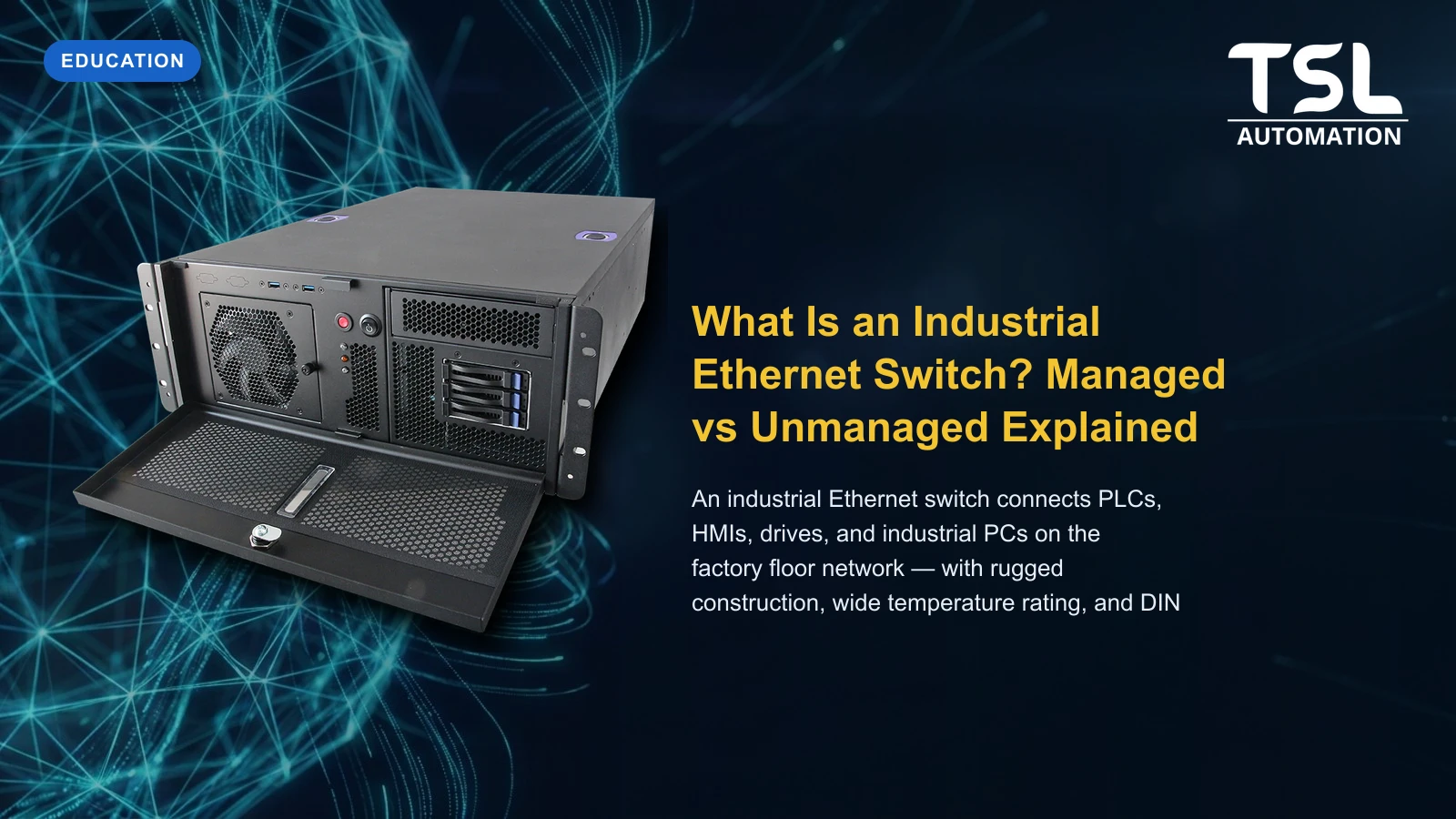
Table of Contents
Why Use an Industrial Ethernet Switch?
Commercial Ethernet switches (office/consumer grade) are designed for clean, temperature-controlled environments with normal humidity. An industrial factory floor has: vibration, dust, humidity, wide temperature swings, and electrical noise from VFDs and contactors. Industrial switches are specifically designed for these conditions — DIN rail mounting, conformal-coated PCBs, wide operating temperature (−40°C to 75°C), and 24V DC power input.
Managed vs Unmanaged Industrial Switches
| Feature | Unmanaged | Managed |
|---|---|---|
| Configuration | Plug and play | Web GUI / CLI / SNMP |
| VLANs | No | Yes — for OT/IT segmentation |
| Port mirroring | No | Yes — for network diagnostics |
| QoS / prioritisation | No | Yes — for real-time traffic |
| Ring redundancy | No | Yes (RSTP, MRP, HSR) |
| SNMP monitoring | No | Yes — for network health monitoring |
| Cost | Lower | Higher |
| Best for | Simple star topologies | Complex or critical networks |
Ring Redundancy: Why It Matters
In a ring topology, all switches are connected in a loop — if one cable or switch fails, traffic re-routes through the ring in the opposite direction. IEC 62439-3 (HSR/PRP) and proprietary ring protocols (Siemens MRP) provide sub-50ms failover time — essentially zero impact for most control applications. Ring redundancy is recommended for any critical production network where a single cable break must not halt production.
Frequently Asked Questions
TSL Automation Solutions
Head of Marketing, TSL Automation Solutions
Sanjana covers industrial automation trends, product launches, and technology insights for TSL Automation Solutions, a Mumbai-based distributor of HMI, Panel PC, and embedded computing systems serving manufacturers across India and globally.
Need help choosing the right product?
Our team in Mumbai can recommend the right HMI, Panel PC, or embedded system for your application.
Contact TSL Automation