
Avalue · Système informatique
EPS-CFS2
*Prix sur demande. Contactez-nous pour un devis.
Points forts
- Processeurs Intel® Core™ i7/i5/i3/Pentium®/Celeron® de 8e/9e génération
- Chipset Intel® Q370/H310 Express
- Intel® UHD Graphics 630/610
- Mémoire max. jusqu'à 32GB DDR4 2666
- Température de fonctionnement -10~45C
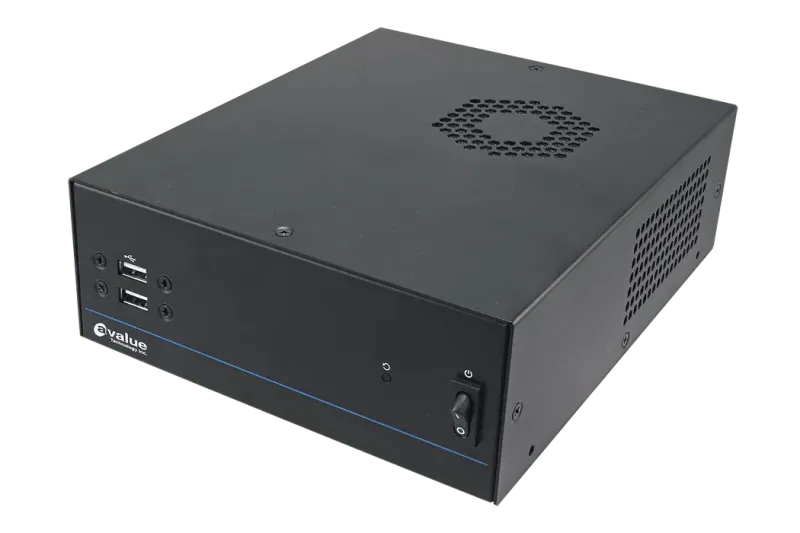
- Conception compacte (170 mm x 195 mm x 65 mm)
- Conception à ventilateur intelligent
- Prise en charge RAID 0/1 (Q370 uniquement)
- Prise en charge du TPM 2.0 firmware
Description du produit
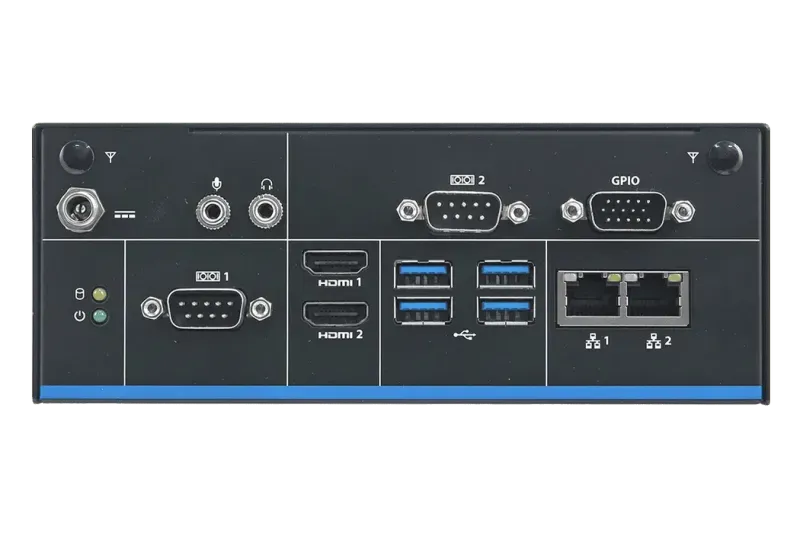
L'Avalue EPS-CFS2 est un système informatique industriel compact et sans ventilateur, optimisé pour les applications mobiles et véhiculaires. Il offre une connectivité robuste avec de multiples ports d'E/S, notamment USB, LAN et COM.
Conçu pour fonctionner dans des environnements difficiles, l'EPS-CFS2 prend en charge une large plage de température, garantissant des performances fiables dans des conditions exigeantes.
Ce système est idéal pour des applications telles que le transport, la gestion de flotte et d'autres usages industriels où la durabilité et le fonctionnement continu sont essentiels.
Caractéristiques techniques
Processeur
Intel® Core™ i7-8700T Processor (12M Cache, up to 4.00 GHz)
Intel® Core™ i5-8500T Processor (9M Cache, up to 3.50 GHz)
Intel® Core™ i3-8100T Processor (6M Cache, 3.10 GHz)
Intel® Pentium® Gold G5400T Processor (4M Cache, 3.10 GHz)
Intel® Celeron® G4900T Processor (2M Cache, 2.90 GHz)
Intel® Core™ i7-9700TE Processor (12M Cache, up to 3.80 GHz)
Intel® Core™ i5-9500TE Processor (9M Cache, up to 3.60 GHz)
Intel® Core™ i3-9100TE Processor (6M Cache, up to 3.20 GHz)
Platform Controller Hub
Intel® Q370 Express Chipset
Intel® H310 Express Chipset
Mémoire système
1 x 260-pin DDR4 SODIMM 2400/2666MHz up to 32 GB
Chien de garde (watchdog)
H/W Reset, 1sec. ~ 65535sec. and 1sec./step
Surveillance de l'état matériel
Monitoring System Temperature, Voltage and FAN Status with Auto Throttling Control
SBC
ECM-CFS
TPM
TPM 2.0 (Firmware)
Température de fonctionnement
With extended temperature peripherals:-10°C ~ 45°C (14°F ~ 113°F) with 0.5m/s air flow(i5/i7 CPU)
With extended temperature peripherals:-10°C ~ 40°C (14°F ~ 104°F) with 0.2m/s air flow(i5/i7 CPU)
With extended temperature peripherals:-10°C ~ 30°C (14°F ~ 86°F) with 0.5m/s air flow(i3-8100T)
Température de stockage
-30°C ~ 70°C (-22°F ~ 158°F)
Humidité en fonctionnement
40°C @ 95% Relative Humidity, Non-condensing
Dimensions (larg. x long. x haut.)
170mm x 195mm x 65mm
Poids
2.3kg (w/ package)
1.8kg (system)
Test de vibrations
With SSD: 1.5 Grms, IEC 60068-2-64, Random, 5 ~ 500Hz, 30min/axis
Test de chocs
With SSD: 10g, IEC 60068-2-27, 11ms
Test de chute
ISTA 2A, IEC-60068-2-32 Test : Ed
Kit de montage
Wall Mount kit (Standard)
mPCIe
1 x mPCIe Socket
(Q370 w/PCIe/SATA/USB 2.0)
(H310 w/SATA/USB2.0)
mSATA
1 x mSATA
Baie de disque 2,5
2 x 2.5" Drive Bay (Internal)
USB
2 x USB 2.0
USB
4 x USB 3.2 (w/Q370 Gen. 2, w/H310 Gen. 1)
Port COM
2 x RS-232
Voyant LED
1 x Power on/off LED on Rear side
1 x Storage Access LED on Rear side
Port LAN
2 x RJ45
Audio
1 x Mic-in
1 x Line-out
E/S numériques
1 x 8-Bit GPIO
Antenne
2 x Antenna Mounting Hole
Entrée CA/CC
Lockable DC Jack
Codec audio
Realtek ALC888S
Chipset graphique
Intel® UHD Graphics 630 (i7-8700T, i5-8500T, i3-8100T)
Intel® UHD Graphics 610 (Pentium G5400T, Celeron G4900T)
Résolution
2 x HDMI: Max. Resolution 4096x2304 @ 24Hz
Informations de certification
CE, FCC Class B
Chipset LAN
1 x Intel® I211AT
1 x Intel® I219LM
Spécifications
10/100/1000 Base-Tx GbE compatible
ACPI
Single Power ATX Support S0,S3, S4, S5
ACPI 5.0 Compliant
Mode d'alimentation
AT/ATX (ATX is default setting)
Adaptateur
Input: 100 ~ 240Vdc/ 50 ~ 60Hz
Output: AC-DC 120W Adapter
OS
Win10, Linux
Informations de commande
Intel® 8th/9th Coffee Lake Rugged Embedded System (w/Fan)
With Intel® Q370 Chipset
EPS-CFS2-Q37-B1-1R (i7-8700T)
EPS-CFS2-Q37-B1-2R (i5-8500T)
EPS-CFS2-Q37-B1-3R (i3-8100T)
EPS-CFS2-Q37-B1-4R (Pentium Gold G5400T)
EPS-CFS2-Q37-B1-5R (Celeron G4900T)
EPS-CFS2-Q37-B1-6R (i7-9700TE)
EPS-CFS2-Q37-B1-7R (i5-9500TE)
EPS-CFS2-Q37-B1-8R (i3-9100TE)
With Intel® H310 Chipset
EPS-CFS2-H31-B1-1R (i7-8700T)
EPS-CFS2-H31-B1-2R (i5-8500T)
EPS-CFS2-H31-B1-3R (i3-8100T)
EPS-CFS2-H31-B1-4R (Pentium Gold G5400T)
EPS-CFS2-H31-B1-5R (Celeron G4900T)
EPS-CFS2-H31-B1-6R (i7-9700TE)
EPS-CFS2-H31-B1-7R (i5-9500TE)
EPS-CFS2-H31-B1-8R (i3-9100TE)
Qu'est-ce que le EPS-CFS2 ?
The EPS-CFS2 is a système informatique manufactured by Avalue, designed specifically for compact-computing-system applications. It features réseau of Monitoring System Temperature, Voltage and FAN Status with Auto Throttling Control, os of Win10, Linux and certification of CE, FCC Class B. L'Avalue EPS-CFS2 est un système informatique industriel compact et sans ventilateur, optimisé pour les applications mobiles et véhiculaires. Il offre une connectivité robuste avec de multiples ports d'E/S, notamment USB, LAN et COM. Conçu pour fonctionner dans des environnements difficiles, l'EPS-CFS2 prend en charge une large plage de température, garantissant des performances fiables dans des conditions exigeantes. Ce système est idéal pour des applications telles que le transport, la gestion de flotte et d'autres usages industriels où la durabilité et le fonctionnement continu sont essentiels.
Caractéristiques et avantages clés
- Processeurs Intel® Core™ i7/i5/i3/Pentium®/Celeron® de 8e/9e génération
- Chipset Intel® Q370/H310 Express
- Intel® UHD Graphics 630/610
- Mémoire max. jusqu'à 32GB DDR4 2666
- Température de fonctionnement -10~45C
- Conception compacte (170 mm x 195 mm x 65 mm)
- Conception à ventilateur intelligent
- Prise en charge RAID 0/1 (Q370 uniquement)
- Prise en charge du TPM 2.0 firmware
Applications et cas d'usage
Le EPS-CFS2 est idéal pour de nombreuses applications d'automatisation industrielle :
- High-performance computing and data processing tasks
- Memory-intensive applications and multitasking
- Industrial computing and data processing
- Edge computing and IoT applications
- Real-time monitoring and control
- Industrial automation systems